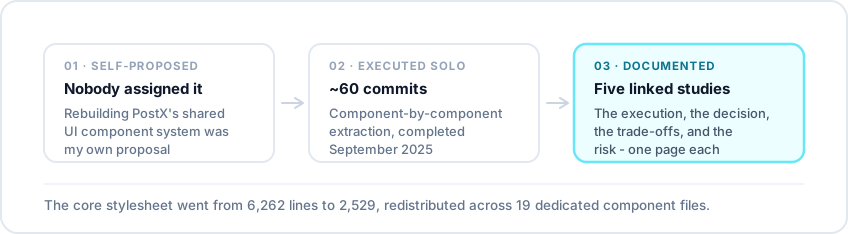
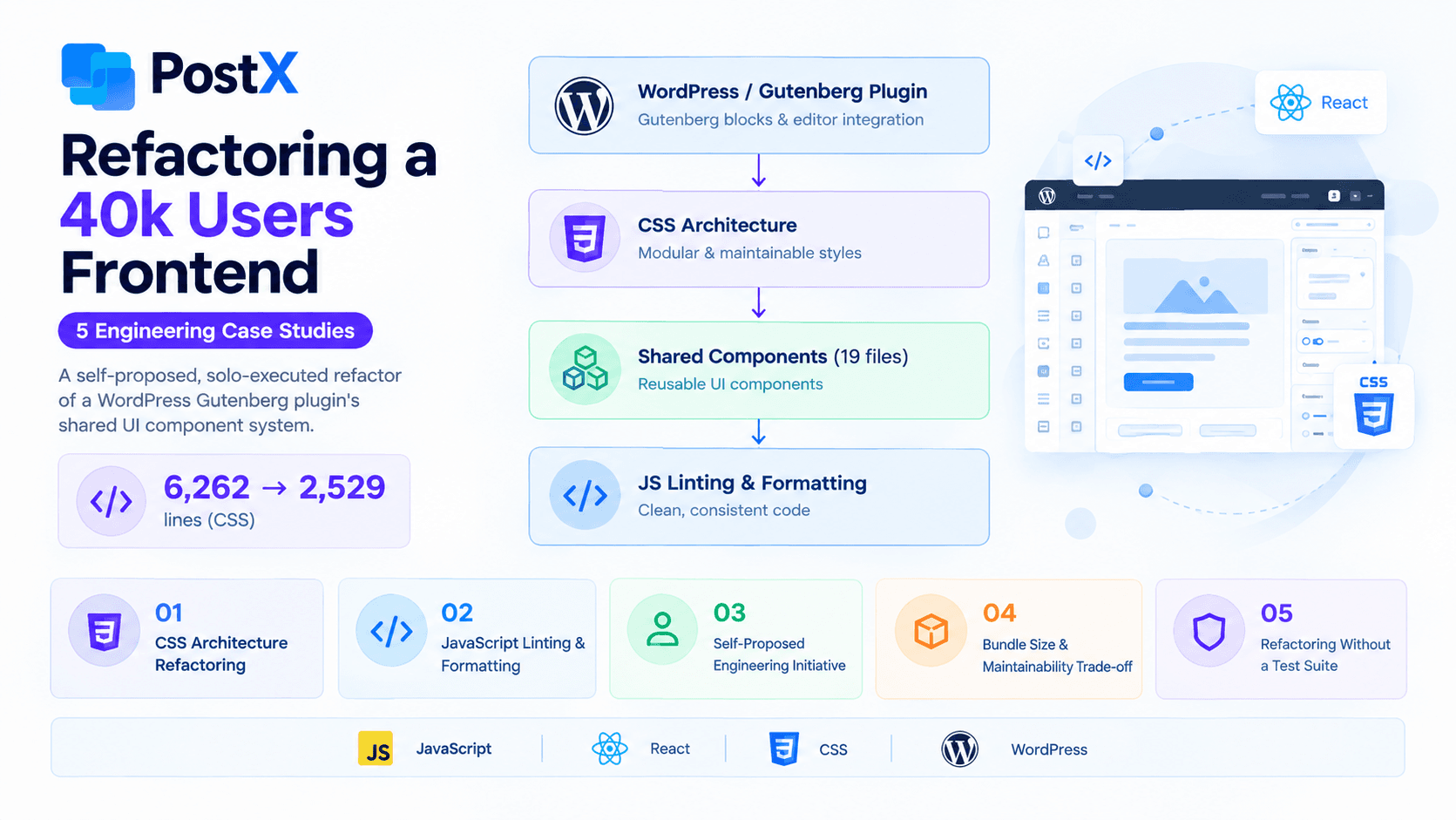
I rebuilt PostX's shared UI component system in a self-directed initiative completed September 2025. The core stylesheet shrank from 6,262 lines to 2,529 lines, split across 19 dedicated component files. The work was self-proposed, executed solo, and is documented here across five linked case studies covering the technical execution, the decision-making, the trade-offs, and the risk.
The initiative
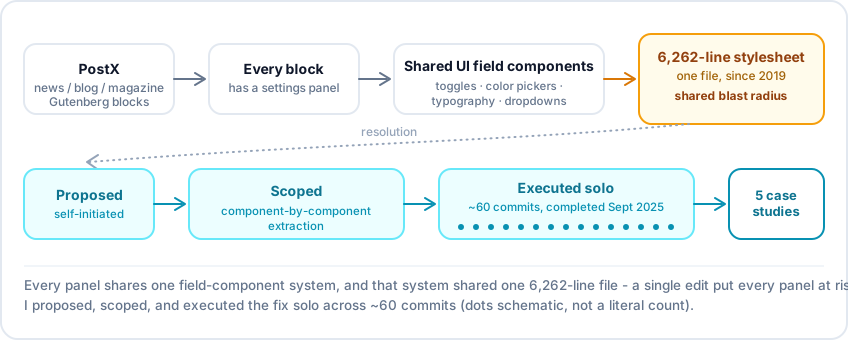
PostX is a WordPress plugin for building news sites, blogs, and magazine-style layouts using Gutenberg blocks. Every block has a settings panel. Every settings panel uses the same set of shared UI field components - toggles, color pickers, typography controls, dropdowns, and more.In mid-2025, all of those components' styles lived in one 6,262-line stylesheet dating back to 2019. Editing any field type meant opening a file that controlled every other field type at the same time. That was a shared blast radius, and it was actively slowing feature work down.I proposed fixing it. I scoped a component-by-component extraction, got alignment, and executed it solo across ~60 commits, completed September 2025.
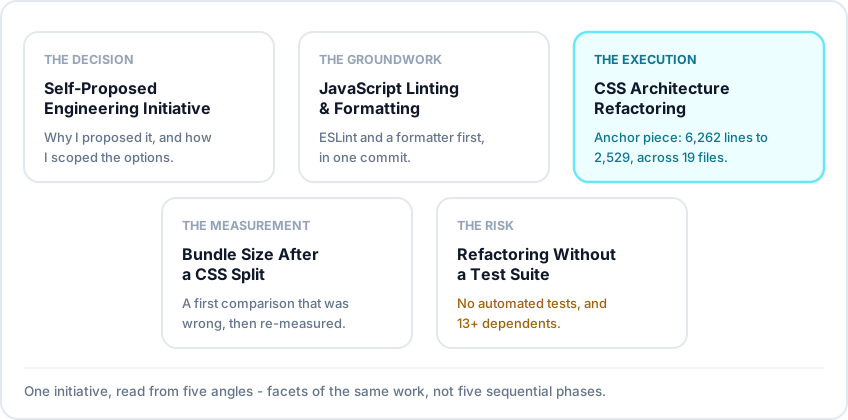
The decision-making case study. Why I proposed this myself, how I scoped the options, and what it means to make the call to pause feature delivery to fix the thing that's slowing feature delivery down.
The paired initiative. Before touching the CSS system, I added ESLint and a JS formatter to the PostX codebase - one commit - as groundwork for the larger structural work that followed.
The anchor piece. Before/after folder structures, the commit series, and line counts. The core stylesheet went from 6,262 lines to 2,529 lines, split into 19 dedicated component files.
The measurement case study. I expected splitting one file into 19 to cost bundle size, and my first comparison said it did - until I found the range included unrelated image assets. Re-measured, affected assets came in 20-30% smaller.
The risk case study. PostX had no automated tests. The system I was changing had 13+ dependents. Here's how I managed that risk without a safety net.
FAQ
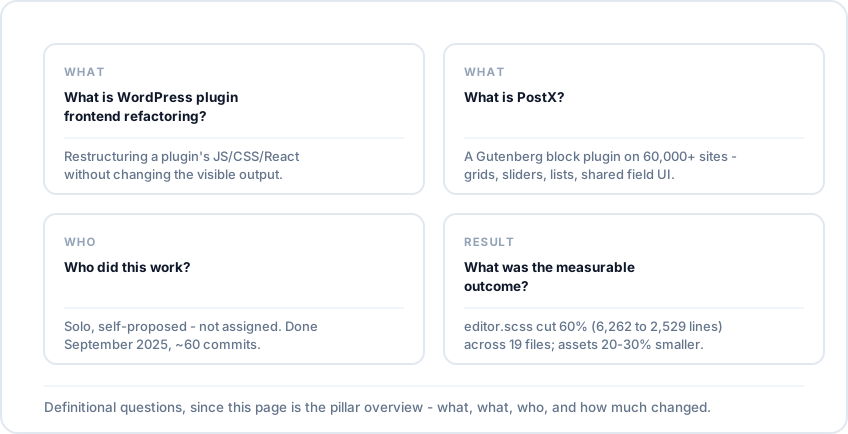
What is WordPress plugin frontend refactoring?
It's the process of restructuring the frontend code of a WordPress plugin - its JavaScript, CSS, and React components - to improve maintainability, reduce technical debt, or remove architectural constraints, without changing the visible output for end users.
What is PostX?
PostX is a WordPress Gutenberg block plugin used by 40,000+ users to build news sites, blogs, and magazine-style layouts. It provides post grid, slider, list, and other blocks, each with a settings panel built from shared UI field components.
Who did this work?
I executed this initiative solo. It was self-proposed - not an assigned project - and was completed September 2025, across approximately 60 commits.
What was the measurable outcome?
The core stylesheet (editor.scss) shrank from 6,262 lines to 2,529 lines - a 60% reduction - with that logic redistributed into 19 dedicated component files. Affected build assets came in 20-30% smaller once the change was measured in isolation, and each field type became independently editable.